
POTS REPLACEMENT
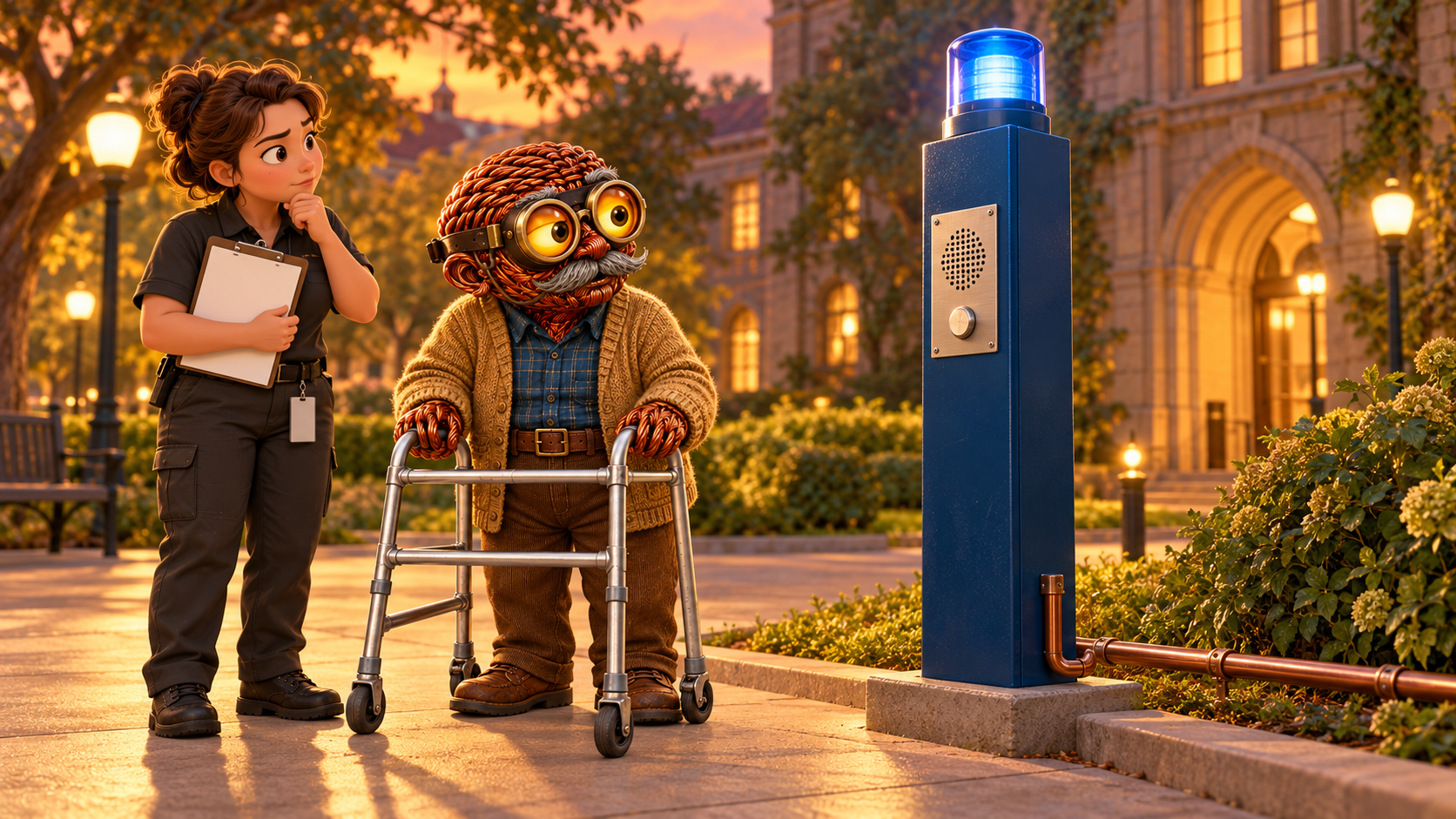
Your Emergency Call Box Is Lit. Can It Still Reach Help?
By Arvin Chaudhary
If your organization has blue-light emergency call boxes on campuses, parking areas or other sites, a lit beacon does not prove that a call will reach help. On some models the light and the phone are powered separately, and the phone may still depend on a copper line that carriers can now retire or replace under faster federal procedures. Before any line behind those boxes changes, test every box end to end, record the result, and make a passing test a condition of approving the replacement.
The light is not the call
On some call boxes, the light and the phone run on different power. One manufacturer’s tower phone manual lists phone power as “Telephone line powered,” while the blue beacon runs on a separate 120V AC or 12V DC adapter. On models like these, a working light says nothing about the phone line behind it.
The same manual says its phones dial up to five programmed numbers and send a location ID code or voice announcement. It also warns that some phone systems might not be compatible with its emergency phones. Your models may work differently, which is exactly why each box needs its own test.
The federal rules changed on October 15, 2026
Amended FCC rules on copper retirement and service discontinuance took effect on October 15, 2026. Three points matter for call box owners:
- Copper retirement rules do not require direct notice to retail customers. Under the standard notice procedure, an incumbent local telephone carrier retiring copper must serve notice on the telephone providers that directly interconnect with its network and on 911 service providers, at least 90 days before implementation, or 15 days when the copper is not being used to serve any customers. It may post that notice on its website instead of serving it directly only for an interconnecting provider that has agreed to receive notice that way. The rule does not require notice to the carrier’s retail customers.
- Discontinuing a service requires written customer notice. Before a carrier applies to discontinue, reduce or impair a service, it must notify each affected customer in writing, including the planned date, the areas affected and the type of service. The rule does not set a fixed number of days of advance notice to customers.
- Some discontinuances are granted automatically. An application is generally granted automatically on the 31st day after the FCC releases public notice of the filing, unless the FCC tells the carrier the grant will not be automatic. When a carrier is replacing an existing retail service with newer technology, automatic grant is available only if it certifies that at least one qualifying replacement voice service, such as facilities-based interconnected VoIP or qualifying mobile wireless, is available in every location throughout the affected service area.
The practical point: don’t wait for a letter. Find out now which call boxes still depend on copper.
A plan for every site
- List every call box. Record its location, model, phone number, line type (copper or not), who answers the call and who maintains it. Include boxes that are not on copper so they stay in the testing program.
- Match each box to your carrier records. Keep any carrier notice with the record for the box and address it covers. Don’t apply one site’s date to every site.
- Set up the test before anyone presses the button. Agree on it with security, whoever answers the calls and your equipment contractor. If calls go to 911, schedule the test with your local 911 center through its non-emergency number.
- Test every box, not a sample. Check that the call reaches the right place, both sides can hear clearly, the location comes through and any backup numbers work. Record the date, the tester and the result.
- Give every failed test an owner and a fix date. Retest after the repair.
Before you approve a replacement
- Ask your equipment contractor and the proposed provider to confirm the replacement works with each installed model at each site, not just in a demo.
- Ask what happens during a power or internet outage. Check with your local fire marshal or building official, and your licensed contractors, before settling on backup power.
- Review call boxes separately from elevator phones and fire alarm lines. Each has its own requirements, so don’t borrow a backup time or approval from one for another.
- Retest every box after the switch, and hand the records to the team that maintains them.
Our perspective
Make a passing call test at every emergency call box a condition of approving any replacement. A lit beacon and a sample of good tests are not enough when someone needs help. Nadicent helps organizations reconcile lines, bills, locations, devices and owners; trace the safety and operational function behind each connection; classify risk; and sequence the cutover with testing and final records, coordinating IT, facilities, safety and procurement. Licensed contractors and your local authorities handle installation and code questions.
Can your team show the latest call test result for every emergency call box you own?
Sources
- Viking Electronics, Tower Phones Product Manual (DOD 217, Rev D), September 7, 2022: https://vikingelectronics.com/wp-content/uploads/Tower_Phones.pdf
- 47 CFR 51.333, Notice of network changes: Short-term network changes and copper retirement (eCFR, current text accessed November 11, 2026): https://www.ecfr.gov/current/title-47/chapter-I/subchapter-B/part-51/subpart-D/section-51.333
- 47 CFR 63.71, Procedures for discontinuance, reduction or impairment of service by domestic carriers (eCFR, current text accessed November 11, 2026): https://www.ecfr.gov/current/title-47/chapter-I/subchapter-B/part-63/subject-group-ECFR2e032f7fd1b825b/section-63.71
- Federal Communications Commission, Reducing Barriers to Network Improvements and Service Changes, Report and Order FCC 26-19, Federal Register, April 20, 2026: https://www.govinfo.gov/content/pkg/FR-2026-04-20/pdf/2026-07622.pdf
- Federal Communications Commission, Final rule; announcement of effective date (amendments to 47 CFR 51.333 and 63.71, among others), Federal Register, October 1, 2026: https://www.govinfo.gov/content/pkg/FR-2026-10-01/pdf/2026-20192.pdf
- National 911 Program (NHTSA), Frequently Asked Questions, last updated March 8, 2023: https://www.911.gov/calling-911/frequently-asked-questions/
This article is general information, not legal or compliance advice. Requirements vary by location and change over time, so check the sources above and confirm with your local authorities and licensed contractors.